
Part 1 of 3: Understanding Metadata Standards for Digital Heritage
When Standards Feel Like Chaos
You've just inherited your institution's archives. Congratulations! Three centuries of letters, manuscripts, and photographs are now your responsibility — along with one deceptively simple request from leadership: "Can you just put them online?"
So you do what any archivist or librarian would do: you Google, or more likely, spiral down an endless rabbit hole of ChatGPT, Claude, or your favorite flavor of AI.
Within minutes, you're knee-deep in alphabet soup: Dublin Core, MODS, EAD, RAD, METS, PREMIS, FADGI, ISO 23081, and something called OAIS.
It's overwhelming, even with AI's "expert" summaries, tables and assurances that you've struck gold. But here's the truth: none of these standards exist to confuse you. They exist to protect you — and your data — from chaos.
The Hidden Cost of Making It Up As You Go
Imagine you create your own metadata structure:
| Field | Example |
|---|---|
| Item Name | "Letter from Mother Agnes" |
| Date-ish | "1890s?" |
| Who Made It | "Sr. Mary Agnes" |
| Where Found | "Trunk in Convent Attic" |
It's easy to understand — for now.
But what happens when your institution migrates systems, or joins a national portal, or collaborates with another archive?
Each institution's homegrown schema becomes its own dialect. One says creator, another says maker, a third says author. Machines can't tell they mean the same thing. Your metadata, painstakingly entered, becomes a beautiful but isolated language — intelligible only within your system.
A Cautionary Tale
This is exactly what happened in the early digital heritage world. Thousands of institutions created one-off systems in the 1990s and 2000s. The cost of retrofitting them to work together has been staggering.
That's what metadata standards prevent. They provide a shared vocabulary that enables your data to communicate across systems, institutions, and time.
Standards as the Grammar of Digital Heritage
Metadata standards are the grammar of digital preservation. They don't stifle creativity — they make communication possible.
Here are the key structures in the metadata landscape:
- Dublin Core — Gives everyone a shared basic vocabulary — a way to describe any resource in fifteen universal fields.
- MARC 21 — Remains the backbone of library catalogs worldwide.
- MODS and EAD — Extend that grammar for libraries and archives that need richer, domain-specific nuance.
- METS — Becomes the syntax, wrapping everything together — descriptive, technical, and preservation metadata in one coherent package.
- TEI — Provides deep encoding for textual documents, manuscripts, and scholarly editions.
- PREMIS — Adds the verbs — documenting what happened to a digital file.
- ISO 23081 — Defines the context, ensuring every record remains authentic, accountable, and traceable.
- OAIS (ISO 14721) — Provides the architecture for long-term digital preservation.
- FADGI and MIX — Describe the imaging metadata that prove your digital surrogate faithfully represents the original.
- JSON-LD and Schema.org — Enable structured data for the web and linked-data networks.
- BIBFRAME — The Library of Congress's modern successor to MARC for bibliographic data.
- IIIF — The International Image Interoperability Framework for sharing and presenting images across platforms.
- RiC-O — Records in Contexts, a new ontology-based archival description standard.
The Critical Distinction: Archival vs. Bibliographic Description
Before you can choose which "grammar" to use, you need to understand a fundamental split:
Libraries describe published items at the individual item level. Each book gets its own catalog record.
Archives describe unique materials using a hierarchical approach. You describe the collection, then the series, then the file, then the item.
Mixed Collections
Museums and historical societies often have mixed collections requiring hybrid approaches: Dublin Core for broad interoperability, EAD for archival materials, MODS for rare books.
The Electric Outlet Analogy: Interoperability
Think of metadata standards like electrical outlets.
Yes — every country could invent its own plug shape and voltage. But travel would become impossible without a suitcase full of adapters.
Standards ensure your data can "plug in" anywhere:
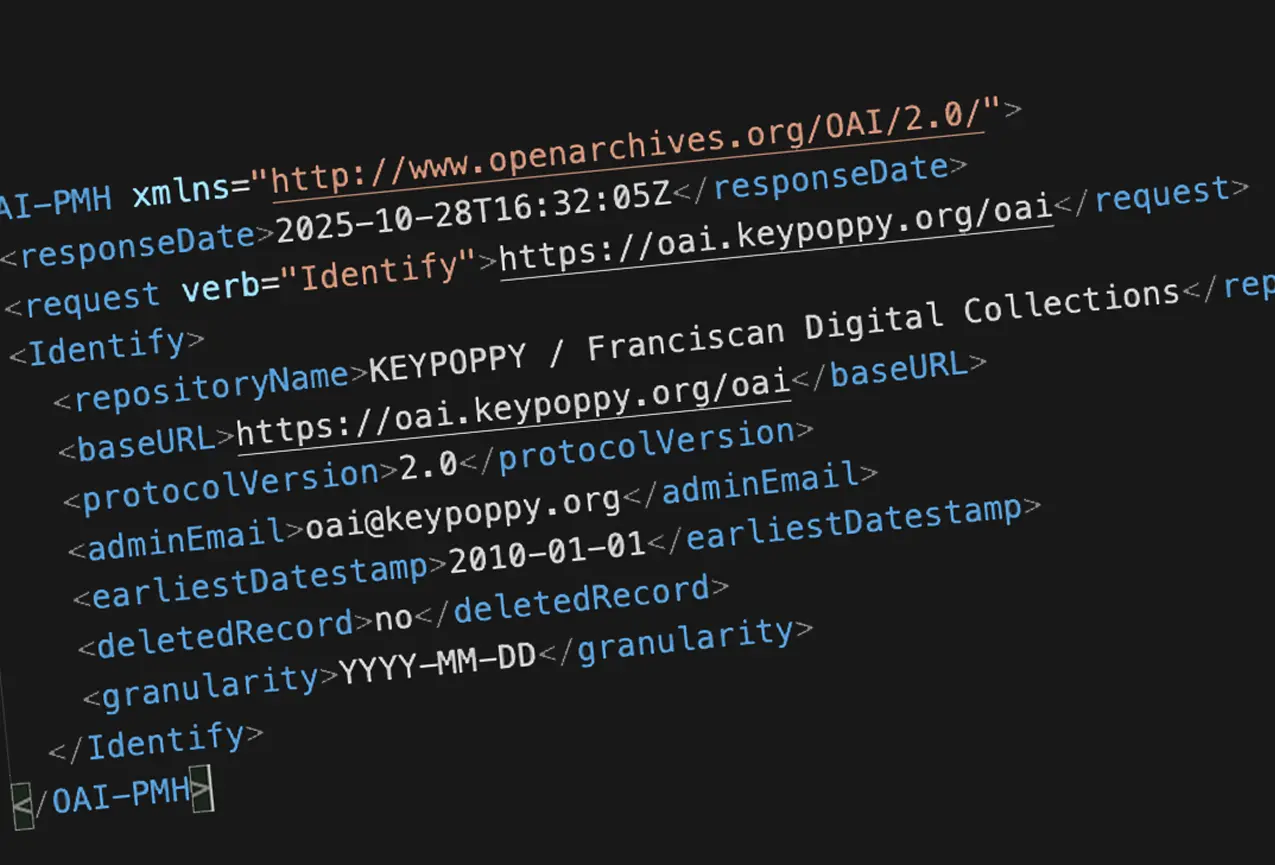
- To discovery portals (OAI-PMH harvesting)
- To preservation repositories (Fedora, LOCKSS)
- To linked-data networks (schema.org, RDF)
- To international aggregators (Europeana, DPLA)
Without standards, your beautiful digital archive becomes a walled garden — full of treasures no one can find.
The Rednal Approach: Standards at the Boundaries
At KEYPOPPY, our digital collections platform Rednal takes a pragmatic stance: internally, your data can be structured in whatever way serves your workflows best. But at the boundaries — where your data meets the outside world — it speaks standards fluently. IIIF manifests, OAI-PMH endpoints, Dublin Core exports, Schema.org markup. This means you get the flexibility of custom workflows with the interoperability of global standards.
The Preservation Paradox
Digital preservation isn't about keeping bits alive; it's about keeping meaning alive.
Standards like PREMIS, METS, and OAIS ensure that if your current system disappears, another repository can still reconstruct the digital object's integrity — its provenance, authenticity, and fixity.
That's the difference between "we still have the file" and "we can still trust the file."
Or as preservation experts say: "If it's not documented, it's not preserved."
The FADGI Principle: Quality You Can Prove
Digitization standards like FADGI go beyond technical specifications — they're about trust.
When you digitize according to FADGI's imaging and metadata guidelines, you produce digital objects with verifiable quality — measurable against objective benchmarks.
That means:
- Consistent tone and resolution
- Standardized color targets
- Embedded technical metadata (using MIX)
- Reusable, preservation-grade TIFFs with proper Exif/XMP metadata
Without this, future users can't know whether a scan was faithful or flawed. Standards let you prove that your digital surrogates are both authentic and reproducible.
Why Standards Matter: Three Real-World Scenarios
Scenario 1: The Grant Requirement
You're applying for an NHPRC digitization grant. The application asks: "Describe your metadata standards and long-term preservation plan."
If you answer "We use a custom Excel spreadsheet," you've just signaled that your project has no sustainability plan. If you answer "We will create Dublin Core descriptive metadata wrapped in METS containers with PREMIS preservation metadata, exportable via OAI-PMH," you've demonstrated professional competence. Funding secured.
Scenario 2: The Partnership Opportunity
A national aggregator invites your institution to contribute records. They require OAI-PMH harvesting with Dublin Core metadata.
If your data is trapped in a custom format, you'll spend months mapping and cleaning before you can participate. If your metadata is already standards-compliant, you can say yes immediately — and your collections reach a national audience.
Scenario 3: The System Migration
Your collections management software is being discontinued. You need to migrate 50,000 records.
If your metadata is in a proprietary format, you're facing months of manual cleanup. If your metadata is in EAD, MODS, and PREMIS — even if stored in a now-defunct system — any modern heritage platform can import it cleanly.
The Real Value of Standards
| Value | Why Standards Enable It |
|---|---|
| Discoverability | Dublin Core + Schema.org expose your data to aggregators and search engines |
| Preservation | PREMIS + OAIS ensure digital objects survive migrations and audits |
| Reusability | FADGI + MIX enable consistent imaging workflows across institutions |
| Interoperability | METS + OAI-PMH let your data flow into other repositories |
| Trust | ISO 23081 + PREMIS provide documented provenance and authenticity |
The Quiet Power of Doing It Right
Standards aren't just about compliance. They're about connection and continuity.
Every time you fill in a metadata field that conforms to a recognized standard, you're building a bridge — to future users, future systems, and future stewards of cultural memory.
You're ensuring that your collection isn't just online, but understood.
What's Next?
In Part 2: The Seven Standards That Power Digital Heritage, we'll explore which standards you actually need and how they work together — with practical guidance for choosing the right combination for your institution.